Archive | Uncategorized RSS feed for this section

Happy, Thank You!

19 Jun

I have a friend who is waiting to be happy. He waits a lot. Happiness for him is that moment when someone pays him a compliment, or does something nice for him, or boosts his ego in some way. His happiness depends on the other person and how that “other” treats him. So, more often that not, he waits for happiness to show up.

So, the other day when I was reading Paul Tillich, the 20th century’s most profound theologian, and came across his definition of happiness, I had to underline it. My classmates from years ago would be proud of me for reading Tillich because I never understood a word of it the first time around. “Profound” is my way of saying he’s about three levels above my intellectual limit. But I found a book of his sermons, and, thankfully, he preached to real people while he wrote to scholarly intellectuals. In one of those sermons, he declared: “Happiness is a state of mind which lasts for a longer or shorter time and is dependent on many conditions, external and internal”. Dependent on many conditions: that’s my friend who relies on external forces and events to generate his happiness. And when happiness strikes him, he’s upbeat, grateful and on top of the world. When it strikes…

My friend’s mantra, during his happy moments, is: “I’m happy; therefore, I am grateful.” But I think he has it just backwards. For him, external events produce happiness which, in turn, produces a sense of gratefulness. His dilemma, like so many other people I know, is that he can’t control the events. So, why not turn the process around?

Try this: “I’m grateful; therefore, I am happy.” Gratefulness is my choice. Gratefulness is an attitude or perspective on the world that I control. It doesn’t depend on anybody else or anything else. And out of that compelling sense of gratitude, happiness is born. So I think I’m going to try as hard as I can to be grateful in this world of wonder, mystery, and beauty. And the next time you see me and ask, “How are you today?”, don’t be surprised to hear: “Happy, thank you!”

Appreciating The Obvious

11 Jun

One thing you learn to appreciate very quickly in the Sonoran Desert is air conditioning. 106 degrees outside today. AC is nice…very nice.

Now that summer has set in I begin to hear “heat” stories. Everybody’s got one, like this. A friend told me recently that she set out the evening meal for her adult German Shepherd dog, a bowl filled with his favorites. But since the bowl was in the kitchen, a room that catches the full blast of the evening summer sun and is therefore quite warm, the dog paused for a few moments, picked up the full dish in his mouth and carried it into the living room. Much cooler in the shaded room…much better for a good supper!

Appreciation is running through my mind these days, especially since I heard Lynne Twist, author of the very good book The Soul of Money, comment about the things we too often take for granted. She said: “What you appreciate, appreciates.” When I slow down enough to notice and value the things I have and the things around me, I begin to see the beauty, value, and benefit of those things. When I stop the endless quest for “more”, I discover that what I have is of great value and its value is enhanced by my appreciation. Common things. Everyday stuff.

How about you? What would be on your list of things in your life that you deeply appreciate? Intently value?

Let me start the list for you…
Friendships, sunrise, conversations, songs, cool wind, fresh rain, second chances, lovely flowers you pass each day. Now you finish the list. Make it your own. Sit down, look around, and appreciate. What you appreciate, appreciates.

I’m Lost!…I Love It!

2 Jun

I’ve known it for a long time, and now I am ready to admit it. I am directionally challenged.

When someone gives me directions, saying: “Go south for a mile and then turn east”, they may as well be speaking a foreign language. I know the sun rises in the east and sets in the west, but that’s the best I can do. Thank God for GPS systems. I’ve been lost in all kinds of places: pastoral countrysides, bustling cities, off-the-map side roads. I’ve seen them all and I usually respond in the same way: “What a waste of my time. I’m supposed to be on Interstate 35, not here in this podunk town.” And so I curse myself, the wadded up map on the passenger seat, and the travel gods who must be laughing at my confusion and frustration.

But I’m rethinking my response to being lost. I’ve decided that since it happens with some regularity, I’ll make the most of it…open my eyes, shut my mouth, and actually try to enjoy the new scenery. All of a sudden I’m discovering very interesting things, quite attractive scenery, friendly people who are willing to give directions and then chat a while, old buildings with fascinating stories, good food in diners that I would never have experienced if I’d cruised along the boring interstate. Now I’m thinking that maybe I try to control my life too much, at least the getting-from-here-to-there part. I think I now love getting lost. There is something valuable in the experience when I decide to appreciate the moment instead of trying to live 10 miles down the road. It’s almost like a refreshment for the soul.

So when I’m 30 minutes late for the meeting and someone says: “Where have you been?” I just tell them that I got lost on the way. And I smile.

Lean Toward The Light

26 May

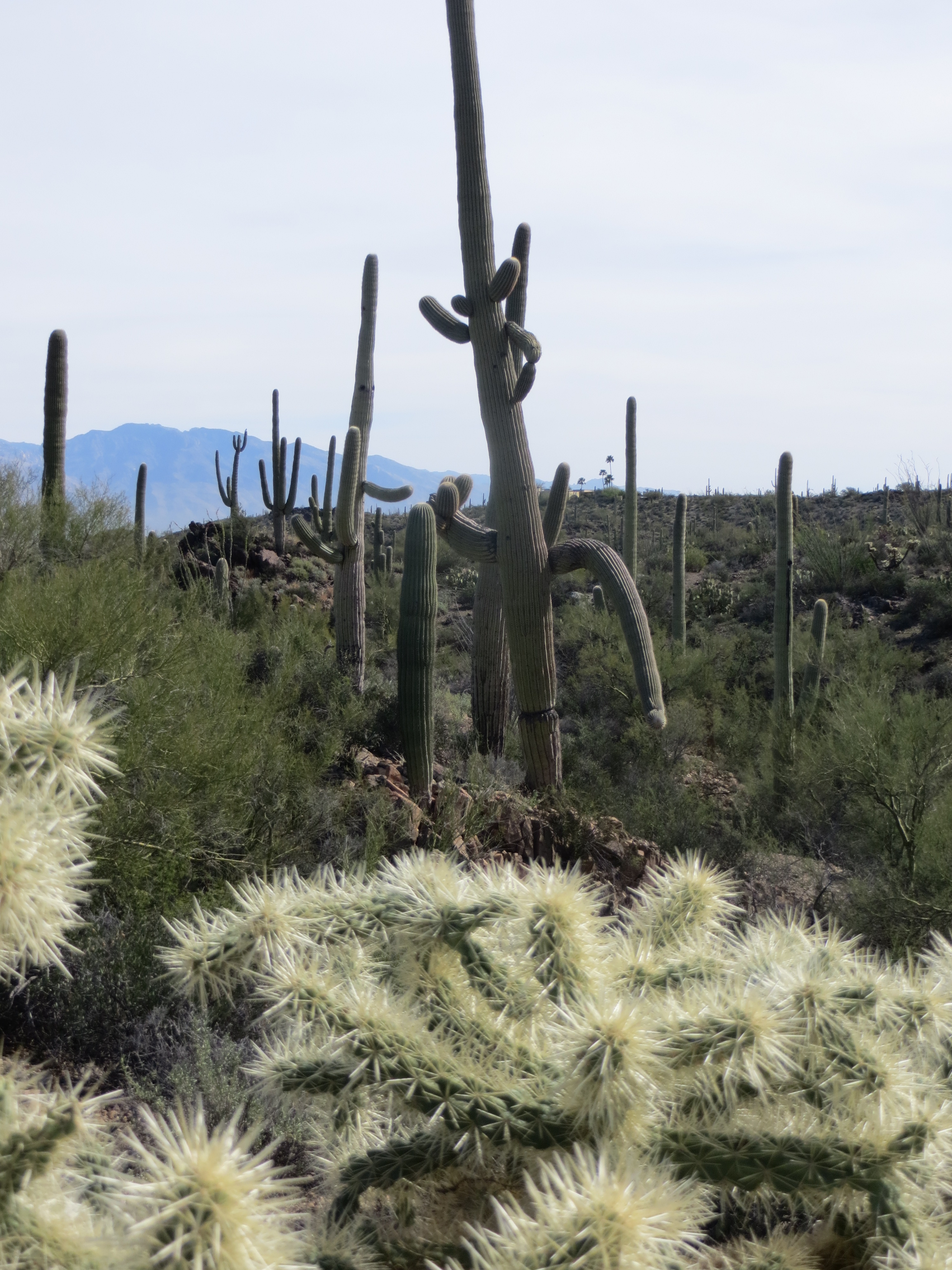
There’s a Tephrocactus Diadematus in my backyard! Before you try to find the dictionary or call an exterminator for me, you need to know that the “TD” is a cactus plant, one otherwise known as a Pine Cone cactus. This is Arizona, so you would expect a cactus plant or two, right?

Well, yes, but this one has the special skill of moving dramatically in order to follow the source of light. (Maybe they all do this, but for the sake of the story, let’s say they don’t and mine is extra special. Thank you.) Anyway, one long, slender arm of the pine cone cactus moves almost 180 degrees so that it finds the most sunlight available. In the morning, the tubular arm is pointed over one side of the maroon pot, then in the evening over the opposite side. It leans toward the light.

“TD” reminds me that sometimes all I, or we, can do is lean toward the light. Here’s what I mean. Like you, I take in the world’s news from several sources. I figure it’s good to balance the news diet, even if it means reading and hearing from news providers whose views are very different from mine. But no matter what the source, I find very little news that makes me want to applaud or cheer or turn cartwheels. Sometimes, but not often enough. Without sounding too much like an old grouch, media covered events in the world today take my breath away…not because I’m delighted, but because I’m disturbed. Deeply disturbed. Politics. Economics. International relationships. The way we treat and mistreat the earth. And after I’ve taken in my daily load of human stupidity and thoughtlessness, I ask the same question: What can I do? How can I, one person, make any difference in this complex and complicated world? And I always arrive at the same answer: Nothing, because I’m too small and “It’s” to big. Realistically I can have no positive effect. Nada. Nothing.

But that was before I sat quietly and learned a lesson from “TD”. I’ve decided to “lean toward the light” in my own life, even though my tiny piece may be miniscule in the grand scheme of things. How I live my one little life, how I treat the few people I see each day, how I spend my money (and where), how I understand my relationship to the planet, how I choose to be and do my life is an act of leaning toward the light…or the darkness. Will it make a big difference and change the town or the city or the country where I live? No. But I will have chosen to place my grain of sand along side yours and his and hers as together we lean toward what is right, just, caring, and honorable.

My thanks to Tephrocactus Diadematus! Here’s to the message of a simple cactus plant: Lean toward the light.

Good News About Dirt

20 May

My grandson recently created a small garden on the side of his house. In the midst of all the stucco homes in a large residential area, right in the middle of the Sonoran Desert, there is now a little patch of green things struggling to live through the fast approaching summer heat. Since we don’t have traditional grass in our yards, he had to scrape away the decorative rocks that cover the ground, then dig down into the hard packed soil. I wasn’t there to see him do this, but I’ll wager that during the tough project he got a load of desert dirt under his fingernails. I hope so. And I hope he might have thought about the dirt as more than an obstacle to overcome, but as a friend who holds his, and our, history.

You probably know that in the Hebrew scriptures, in the book called Genesis, there are actually two creation stories. And they are quite different. In the first one, God has a very linear plan: on the first day this is made, on the second day that. Everything is rather neatly arranged and calculated on through the whole creation process. But the second story is really a story. It is an unfolding of emotion and feeling with a sense of tenderness. Here the creator scoops up a measure of the earth, common dirt, and shapes it into a living being. It’s living because “breath” is puffed into this lifeless creation by Life itself. Try to imagine that wonderful scene in your mind. How different it is from the rather rigidly programmed approached described in creation #1. Some have said that the first creation event is very “male” – rather analytical, structured and organized, while the second depiction is quite “female”. It is tender, much more sensitive and appealing. It’s like a bedtime story instead of a set of construction blueprints. Male? Female? God? I conclude that the Creating Force we name God is without gender, or put another way, is both male and female in every aspect of putting together this wonder-filled reality we call life.

But the thing I like most about the second story, my favorite one, is that God takes earth in hand and makes life…you and me. Common earth, ordinary dirt, is the source of our history. We all come from the same place. We are all related to each other. We belong to each other because we come from the same source. What a marvelous metaphor.

I hope my grandson looked at the dirt under his fingernails before he washed his hands for lunch. I hope it will occur to him that all creation comes from the same beginning, and if that is true, that all life is connected, sacred, and of inestimable value. At age 13, he will need that foundational truth in order to care lovingly for the earth and all that calls earth home.

“Just A Friend”

16 May

When her wheelchair stopped in front of my desk, she looked up, a fragile figure whose narrow face described, without words, the long journey of illness and suffering. If she had been able to stand her height would have been less than five feet. Slumped in the rolling chair, she wore a blue scarf around her head, open on the top so that her thinning hair showed through. A wrap around her shoulders draped down over her lap and almost touched her feet. Her voice matched her appearance, sharp and childlike. The woman was checking into the hospital where I give volunteer hours once each week. Unable to push the wheels of the chair herself, she was accompanied by a tall man, perhaps near 70, who seemed quite attentive to her and spoke on her behalf when her mumbled words were unintelligible.

“I’m just a friend”, he told me.

She wanted me to take a sheet of paper on which were typed words containing, she said, “important information”. When she extended her arm to hand it to me I saw the hospital wrist band that must have remained from a previous visit. I tried to explain to her that in my role as a volunteer I was not privileged to personal, medical information, but she did not understand and my hesitancy must have dredged up old memories of long waits, bureaucratic inconsistencies or the sheer anguish of having to tell her story one more time. She pulled herself back in the chair and then lurched forward in a rocking motion. Back and forth she moved, rocking her upper body more violently as the moments passed. With the jerking movement, she began to whimper, then moan in sounds that got louder and louder. It was then that her companion placed his hand first on her left shoulder, then very gently on the top of her head as it swayed back and forth. Without saying anything to her, he knelt on both knees beside her chair and put his face close so that only she could hear. People in the waiting area were now beginning to notice the moment. Some were watching with growing interest as the man on his knees began to sing softly. The tune was unknown to me; maybe more soothing sounds than familiar melody. He swayed in the same rhythm that she had made, all the time singing his quiet song. It wasn’t long before she began to relax. She took his hand and eventually let his calmness ease her frustration. When she had regained a measure of control of her own emotions and fears, she looked up at me and smiled, as if to say: “I’m here now.”

When all was done and her admission to the hospital was complete, I spoke briefly with her companion. She had suffered greatly for a long time; she was alone in the world with no family; she lived in a care facility where she was one of many who had lost both dignity and determination. Her only outings were to doctors and hospitals; she feared and hated both. I thanked him for his kindness to her and for helping to calm her anguish. He said, again: “I’m just a friend.”

I hope that the next time I am overwhelmed by my own fears or deeply angered by things I can’t control, a friend will sing to me. Just a friend.

Conventional Wisdom

10 May

Wisdom is something we all aspire to and hope to attain. But one kind of wisdom can be tricky, even dangerous. It’s called Conventional Wisdom and is defined in a variety of ways. Here’s one: Conventional Wisdom is a statement that has been heard for such a long time, maybe years or decades, that we all assume it is truth. Just by the repetition of the statement, the words become our reality. Here’s an example: “What’s good for General Motors is good for the country.” I heard that growing up in little snippets of family conversation, but now I doubt that statement is absolute truth. Or how about this: “The purpose and meaning of a woman’s life is to get married, have children, be a supporting wife, and live in a house surrounded by a white picket fence.” We know that’s not true anymore! But those are historical pieces of Conventional Wisdom. Try this more modern one: “Success, or happiness, in life is measured by what you attain, accumulate and possess.” Or, one more: “More is better!”

Conventional Wisdom dissolves when new facts are discovered that strongly suggest or directly contradict the former way of thinking. “More is better” is the perfect example of Conventional Wisdom that will lead to increased problems in the world — economic and cultural ones, for sure. The discovery that undermines the “more is better” idea is unfolding before us as scientists and researchers find that there is and will be a limit to “more”. There aren’t enough life-sustaining requirements, like water, to last forever. “More” is limited by the capacity of creation to renew itself and by how we understand life all around us. The New Wisdom, still unfolding, is the recognition that everything is connected, everything is related and, in relationship, depends on and supports the other. Human beings are not the center of creation, but rather a part of creation. Thinking that “more is better” is replaced by the question “what is enough?” And the deeper question, of course: “How am I related to all that lives on this planet?”

The impulse and drive to have “more” is undermined by the fact that most people on the earth don’t have “enough”.
But there is enough to go around, if we could face the looming consequences of the false Conventional Wisdom that “more is better.”

A Courtyard of Diversity

6 May

I shared a bench today with a man reading a paperback novel. He was on one end turning pages. I was on the other end tapping the screen of my iPad. Two different worlds but joined in the common appreciation of the display before us. That display was a visual delight, one that came together with bright colors on fluttering banners, elementary school children, skipping and dancing, then walking in an almost straight line behind their teacher, shoppers pointing into windows and chatting softly, warm and welcoming Spanish architecture full of stucco archways and soft curves, lovely shade trees moving in the gentle wind, even a light offering of easy jazz as a backdrop to the moment. My bench-mate put his book down as I laid my electronic book aside to take in the lovely spectacle. After a few minutes he turned my way and smiled. I returned his smile: “So many different things to see”, I commented. He was quiet for a moment and then offered one perfectly descriptive word: “Delicious”.