Archive | February, 2025

Watching

28 Feb
img_4446-1

I think they watch us. Not blinking.
Very little motion. Rather nonchalant.
But notice sometime how they follow
human imprints. Maybe they hear us, too.
Much to our shame if they do.
They hear the human vocabulary:
rip and cut and shred and grind.
These delicate watchers are
the guardians of the earth,
witnesses to the heavy hand of
progress, the belching yellow
tractor with the razor-sharp blade,
crushing the tortoise in her den,
inflicting cruel pain on oaks and
pines that stand in the way of
multi-storied apartments
floating in asphalt sea
parking lots.
Pity the poor coyotes, javalinas
that wander into death, lost
in the mayhem not of
their making.

We Can Do No Less

27 Feb

From the mind and heart of Steven Charleston: “Do not read these words unless you are willing to accept them and stand responsible for their meaning. To you, authority has been given to work a wonder in another life. To you, authority has been entrusted to shape a new reality. Be accountable for that gift. Use it with wisdom, aware and intentional, and arise a healer, both born and blessed.” This little paragraph is marked for today’s reading in Charleston’s book Hope As Old As Fire. May I focus just on the first sentence.

In these days of deepening disappointment with the course our nation is taking, there will come a day when even the most hesitant among us will say: Enough. Until then we will read the articles, commentaries, and internet musings of people calling us to hope, to pray, to trust and we will feel an increasing uneasiness about the march of history. But we will continue to search for glimmers of hope,
all the while watching a systematic dismantling take place. I ask you to read Charleston’s first sentence as if the words are addressed to you: “Do not read these words unless you are willing to accept them and stand responsible for their meaning…” Be the prayer you pray. Be the healer you hope for. Be the voice instead of the thought. This is the way of Christ. He became what he was. We can do no less.

Here I Am!

26 Feb

I was thumbing through a little book of quotations the other day and found this: “Wherever you go, there you are.” My first reaction was: Ok, so…? I’ve said things as profound as that and to the best of my knowledge, I’m not in print in any quotations collection. I think I must have filed the quote away in the back of my mind as I moved on to more important things, like eating breakfast and stepping on the bathroom scales. The first is decidedly more pleasant than the second. But somewhere in the developing day, a little light came on in my mind: Oh, that’s what he means. “Wherever you go, there you are.” Sure, I get it. The moment! Be in the moment. Be conscious of this special moment. And that’s important, isn’t it.

More than once I’ve been sitting at my desk in Tucson, but my mind is in Dallas or New York. Some people live their lives that way; they are always somewhere else, reliving the past or projecting into the future. But there is so much beauty around me right now, so many needs to address, so many ways to make life better. If I wander in my mind to Dallas or New York, I’m missing opportunities that Christ is giving me right here, right now. Today is a gift. This moment is a gift. Don’t waste it. So, today practice being where you are. And in your recognition of your gift of the moment, make it count. Do something nice for someone; surprise them. Say something that acknowledges your response to this remarkable gift. Be where you are. Make a difference. And be grateful that you can.

Just Another Monday

24 Feb

Well, it’s Monday.
One more Monday, the start of another week.
Check the calendar: Luncheon tomorrow,
doctor on Wednesday, play bridge Thursday,
Susie visits Friday morning, dog to the Vet,
but nothing much today. Ho! Hum! Just
another Monday. I guess I’ll do my devotions
for the morning. just like every other day.

What if I opened my Bible at random, just held
it in my hand and let it fall open, I wonder what
it would say to me. Don’t know unless you try.
Psalms…humm. Now I’m going to put my
finger on the text…close my eyes and let my
finger fall wherever it wants to.

Well, listen to this: “This is the day the Lord
had made; we will rejoice and be glad in it.”
Rejoice! Be glad! In this day! Yes!! I choose
to be glad! Yes! I might even be happy
about this gift! Funny how a few words
can change everything…I will be glad in it.
I will be glad IN it, not about it. IN it. In
everything that comes my way, I will
choose to be glad, appreciative, thankful.
Thank you, God, for the gift of another
Monday. I’ll watch for you IN it. I know
you’ll be there.

Corner Trinity

23 Feb

At 4:34 this morning, I sat at my desk wondering what my mind and my heart would agree to produce for the day. Neither my mind nor my heart answered. There was a tedious silence. But, I thought, I will offer a few more minutes to the pair, and then it happened. I looked at my not uncluttered desk, over at the corner near the file folders, and there it was. Just what I had been waiting for. A thought desiring to be developed.

This adventure of writing poems began as a diversion. I was onboard a U.S. Navy ship in the middle of an ocean on a calm, placid day with no immediate responsibilities. For reasons I don’t remember, I picked up a pen and jotted down a simple poem. Something about missing home or “thinking of you” lines. And I enjoyed doing that so much that the next day, in a similarly quiet moment, I put more words on paper and found the same feeling of satisfaction. And so it began. That was in the mid-1980s. That was a few years ago. Over the years the number of three-ring binders has increased and the pleasure has never vanished. So to the present moment.

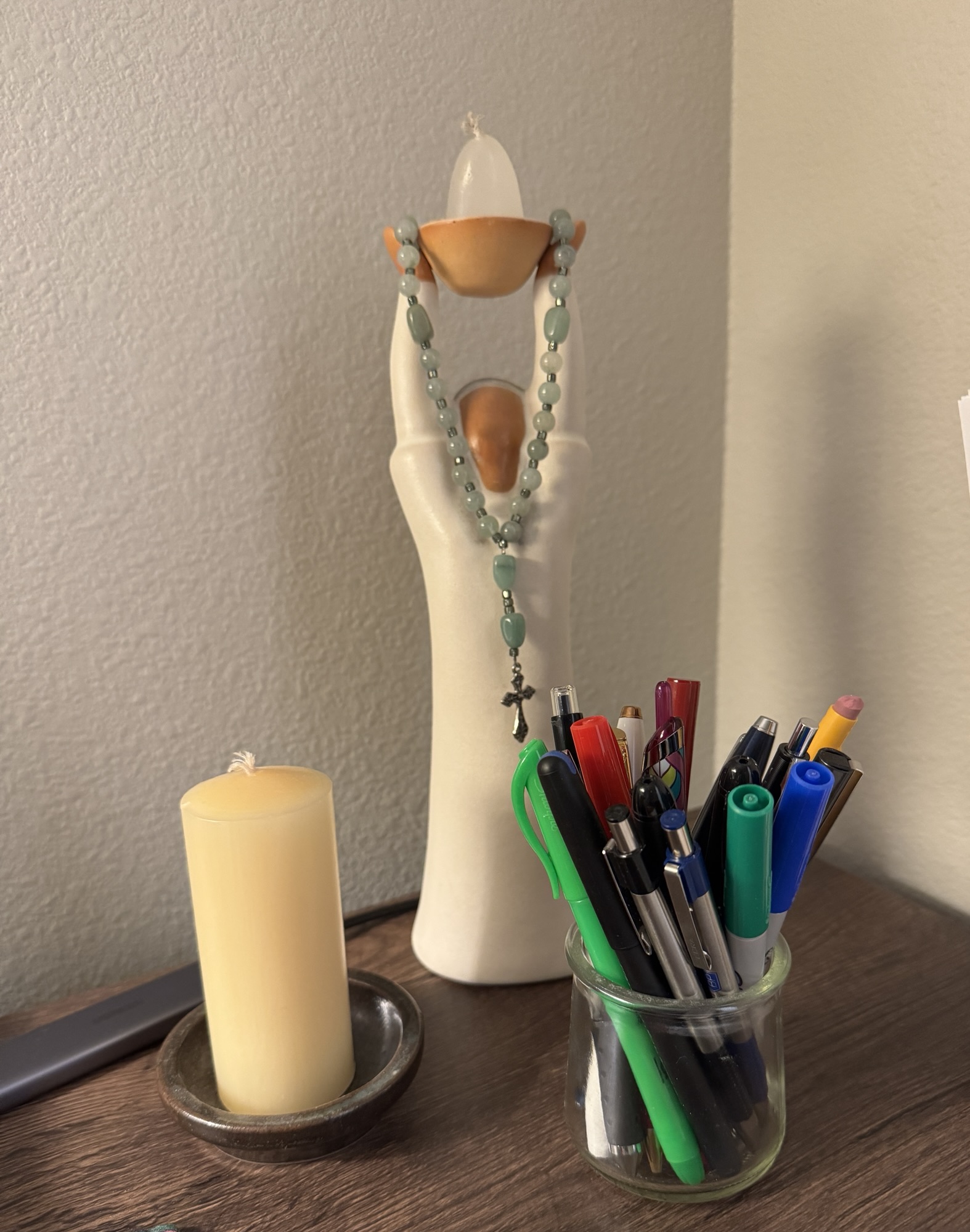
The three objects living together on the corner of my desk are a candle, a ceramic figure of a woman holding a bowl up to the sky and a glass container filled with writing instruments. The candle is the vehicle of Light, the conveyor of a glow that grows into brightness. The figure of the woman and her bowl is the act of reaching up as an empty vessel to be filled with the gift of thought or insight. There is a small candle in her bowl, perhaps waiting for the fire of heaven to create even more light. The prayer guide draped around her bowl is a late addition to the trio. The final piece of the corner trinity is the collection of pens and markers, my necessary instruments for the creation of word stories.

Light as prayerful gift expressed through words from common, ordinary pens. I am deeply grateful for the personal pleasure of creating and organizing words on a page. I know the Source. We collaborate each morning, as in the special gift of this day: light, a prayer, and a pen. You see, now I have something to write about.

Becoming Who We Are

22 Feb

“When I was a child, I spoke like a child, thought like a child, reasoned like a child; when I became an adult, I put an end to childish ways.” Perhaps you will recognize that famous line as the 11th verse of chapter 13 in the New Testament writing called 1st Corinthians. Wouldn’t it be a different world if that was true? Maybe it was true for the writer, Paul of Tarsus, but he’s the same man who, in a different letter to a different church, described himself as a “wretched man,” torn between right and wrong, good and evil. He describes the contest within his mind: I do things I don’t want to do and I leave undone the things I should do. Want and should.

“Tommy, when you play in the sandbox with Billy, you should be thoughtful and kind to him.” “I guess so, Mamma, but he has a toy that I want.” Maybe Tommy will develop a higher moral system when he grows up; maybe he will be introduced to something called a “conscience,” that inner voice that someone once called “the representative of God.” Let no one say, though, that it’s easy to live by the “should” and ignore the “want.” When “want” is out of control, power and greed and popularity become delicious poisons whose lethality is not limited to the one person. Many are infected. Many suffer.

When adult human beings insist on acting like childish human beings, when bragging, boasting and bravado become virtues, those who still hear that inner voice of conscience are faced with tough decisions. Moral decisions. Ethical decisions. Spiritual decisions. Paul of Tarsus, probably in despair, threw up his hands and exclaimed: “who will save me from this body of death?” Who will rescue me from the collision of conscience and childishness? And Paul concludes: “Thanks be to God through Jesus Christ our Lord.” God? Intervening? Solving our problems while we watch? No, but speaking to our hearts, whispering in our minds, calling us to be who we claim to be. The moral imperatives of conscience still exist in good people; they are in the DNA of human beings.

For the welfare of nations and for the benefit of the least among us, we need to listen to the still, small voice. From the integrity of who we are, we need to listen and respond to the highest calling, the welfare of all creation.

Three Words

21 Feb

You’ve heard of “How To…” manuals? How to fix this or how to solve that…you know the term. With that in mind, here are three things, combined from one resource, that you can do to make your life better, more satisfying, and more meaningful:

Trust steadily in God. Steadily, not occasionally, not when necessary, not when you run out of other possibilities. Steadily, which might also mean constantly.

Hope unswervingly in God. Unswervingly, focused, constant, without wandering.

Love extravagantly. Extravagantly, without limits, over-the-top, exceeding the bounds of reason, beyond what is deserved.

These three words appear in the last verses of 1 Corinthians 13, Paul’s wonderful letter to the church meeting in Corinth. Trust (or Faith in some translations), Hope and Love. Is one more urgent that the others? Yes, but I’ll leave that for your reading. Find your Bible and have a look. It’s a life changer!

May this fine day be filled with moments of trusting, hoping and loving, and tonight, when you reflect on this day, may your heart be filled with gratitude and peace. Press on.

Affirmations

20 Feb

When she caught the school bus that morning, everything seemed fine. Homework done. Good mood. A long weekend coming up for a national holiday. Everything was fine when she left home, but not so when she returned. Her Dad looked up as she came into the family room, dropped her overloaded backpack on the floor and slung herself onto the sofa. “Bad day, huh?” “Yeah, you might say that,” came the reply. Then remembering that his daughter had played a soccer game after school, Dad asked the inevitable question: Did you win the game? From that moment on, the conversation went downhill.

You see, if you don’t win, then by definition, you lose. May as well ask: Did you lose again? She stared into her Dad’s eyes for a full minute before breaking down in tears. Yes, a loser again. What Dad didn’t know is that his daughter had scored two goals in defeat. It seemed that winning was all that mattered.
But not all of us are winners, are we? Sometimes it seems like the value of good, honest, hard work is wasted if we don’t win. But wouldn’t it be refreshing, and thoughtful, to affirm each other’s efforts and not just the outcomes. Did you give it your best? Did you try hard? Are you happy with your part in the game? It’s like the dissertation the college student wrote that was taken apart by the review committee. Maybe it wasn’t the most profound academic attempt in the history of the school; maybe it could have been written better. But there’s more to living than winning or losing.

A kind and generous heart affirms the person, even if the outcome is not an A+. So, be generous with your affirmations. The value of a moment is not determined by winning or losing, but by how we have tried with effort, values, principles, integrity. Let’s go out of our way to affirm each other and not calculate success on the basis of winning or losing. Press on, but do so with a compassionate heart.


The Way To Wisdom

19 Feb

It has been said for a long time that the writer of Matthew’s Gospel wanted his readers to view Jesus as the new Moses, and perhaps the most striking illustration of Matthew’s desire to link the two men is the telling of the mountain-teaching experience we have labeled the Sermon On The Mount. Begin at the fifth chapter of Matthew’s writing and read on until you come to the end of chapter 7 and you will have read a wonderful summary of the mind and heart of Jesus. Coincidence that Moses is on the mountain receiving the wisdom of God and Jesus is on the mountain dispensing the wisdom of God? No, Matthew wants us to make the connection between the two occasions. So why and what does it mean to link the two mountain moments? As Moses is the voice of God for a tribal people, so Jesus is the voice of God for the world. Huge crowds forced Jesus to go up the mountain and there he outlined the way life should be lived. Every person of faith should read these three chapters every day. Let your time of meditation, reflection, that quiet moment be spent soaking in the creative wisdom that Jesus brings to the world.

Just as Jesus gives the world some very practical guidelines in the Sermon On The Mount, ways to live a deep spiritual life, other voices of the ages join his in giving the world sacred wisdom. Two examples that address the spiritual life and the practicalities of living in shaky times: “The best revenge is not to be like your enemy.” The second: a one line commentary on an ancient concept that offers very practical wisdom for life: Amor fati (love of life) “is an ancient concept meaning accepting what happens in life and finding meaning in it.” This is not resignation or giving up. This is looking at realities you can’t change and finding a meaning, a direction, in them. The Sermon On The Mount is our roadmap to living a deeply spiritual life and other voices over the ages offer us additional insight and meaning. There is joy, peace and comfort in this world and you will find it when you go into His presence, when you climb that mountain and sit as his feet. May the peace and purpose of Christ fill you this day.

Leaves Falling

18 Feb

A couple of weeks ago, while out for my morning walk, minding my own business and enjoying the crisp air, I was passed on the sidewalk by a Goose, a Duck, a Turkey, and a Chicken. In that order. The Chicken was squawking: “The sky is falling! The sky is falling!” I said: “Chicken, how do you know this to be true?” “Well,” replied Chicken, breathing heavily from the strenuous run, “I know because a piece of it fell on my tail.” It was then that I noticed a brown, wrinkled leaf stuck in Chicken’s tail feathers. But Chicken was flapping down the sidewalk before I could remove it. “It’s a leaf,” I called out, but he was off on his mission.

I later heard that Goose, Duck, Turkey, Chicken and a few other fearful fowls stopped by Fox’s den to alert him to the disaster, were invited in for shelter and safety, shown a big room where they could hide, and that the last thing they heard was the lock on the door clicking into place. Devoured by their fear.

Now, here’s a strange thing: Yesterday it was reported on various Social Media outlets that the sky is, indeed, falling. And, of course, it must be true since it came from Social Media sources. I hesitate to add this final observation: I did see two chickens running along Silverbell Road this morning.

Is it true? Is the sky falling? Maybe. I don’t know and you don’t know. If it is, running in a frenzy isn’t going to stop it. When the house is on fire, yelling doesn’t put it out. Strong feelings might result in positive steps, thoughtful responses, but passion should not produce pandemonium. My counsel to the alarmed Chicken: check your sources, refuse to respond in kind, stand instead of cowering, remember who you are and to whom you belong. “Greater is He that is in me than He who is in the world.” We’ve been saying that for a long time in prayers, sermons and hymns of trust. Now we may have to actually live it. “Fear not…” Jesus used to say. Do the right, the good, the just and never accept a dinner invitation at Mr. Fox’s house. Jesus didn’t say that last part, by the way.

(Acknowledgement to Joseph Jacob who is thought to have been the author of Chicken Little)