I could see this in the distance. I turned the car around and slipped through the downtown area as quickly and as safely as possible. When I got to the beach, I double parked the car, left the door open and dashed across the street, up onto a grassy dune and started snapping. A picture doesn’t do justice to the real thing. But, I have nothing to say about this. No comment, no commentary. I simply ask you to sit quietly for three minutes with this picture. When the three-minute timer goes off, ask yourself one question: ”What do I see in the picture that feeds my spirit, expands my soul?” Listen to the deepest part of yourself. All the other stuff can wait.
Sail On
5 FebI’ve never been onboard a modern, commercial fishing boat, but I’m sure they carry highly sophisticated electronics and are constructed with safety in mind. Still hard work, though. Whether your name is James or John and you run a little family fishing business, or you’re the pilot of a high-tech vessel in the 21st century, fishermen learn their trade quickly or they face disaster. No one controls the big waters. Storms pop up quickly, tides rise and fall and a good fisherman is ready. You can see in the picture how close some fishing boats come to the shore, and that’s another danger area. The last thing you want to do is run aground and be at the mercy of the churning ocean. So, the pilot must know where that imaginary sign is located: “Danger Beyond This Point!”
That’s the life works, isn’t it. Knowing where the boundaries are, limits. Sometimes it’s “how far can I go?” At other times it is “how far should I go…how far must I go?” All depends on the circumstances, I suppose. You and I have been there, in that moment when faced with an ethical or moral dilemma, we make the distinctions, the choices to move ahead, stop, or retreat. Boundaries. Limits. Red lights, yellow and green lights. Ignoring them has consequences. The spiritual path we have chosen to follow, The Way of Jesus, calls us to live thoughtfully, compassionately, and often selflessly. Here are some signs along that path: *Love has no limits. *Think! Use the brain God gave you. *Peace requires an open mind. *Justice requires sacrifice. *Caution: Turn around and go the other way. *Be truthful in all things.
Those signs and many more are inherent in the Gospel, the Good News, of Jesus. Fishermen in his time and today depend a lot on inner knowledge, experience. We call it wisdom. And so do pilgrims traveling The Way of Jesus. He is the Source of life’s fullness. He is the Sign Maker. So, if you find yourself faced with an opportunity, a dilemma, a moment of indecision, the first place to turn is into the heart and the mind of Christ. Knowing how and where and why you steer your ship gives you a pretty good chance of reaching your destination. Sail on.
Kingdom Thinking #3
4 FebYesterday’s posting ended with the suggestion that the Kingdom of God, according to Jesus, is not so much about “saving” as it is about spending, generously giving understanding, compassionate care, hope, love to all people in creation and doing so out of a realization of abundance. That is a function of the new alternative to the brutality and power of the secular kingdom. So, let’s pick up the conversation there.
Another reality about The Way of Jesus: it is not about measuring membership but is about mission. Perhaps you have experience in a church where adding members seemed to be the number one priority. The size of the church somehow signals the depth of faith of members, the skill of leaders. When Jesus talked about building, he meant building up the spirit, the soul of a neighbor or friend. Setting free from bondage will certainly increase one’s hope and change an outlook on society. And that new outlook might lead one to the mission field of your local neighborhood. People of The Way are not counting membership numbers. The are encountering suffering and responding to it as they do the work of God.
Also, in this alternative realm Jesus described, his teachings and demonstrations of love are the standards by which we interpret the scriptures. It’s not the other way around. We ask in a moment of urgency not “what does the bible say” but rather, in this situation what would Jesus do? Jesus is the standard by which we interpret the bible and circulate wonderful news around the world.
Final observation about the work and witness of The People of The Way. On behalf of Jesus they proclaim that Spirit always precedes functional systems. Prayer increases power as one dares to act in the name of Jesus. Spiritual discernment is essential when decisions have to be made. This, I believe, is one of the most important foundational stones of our faith. Systems that reflect integrity and justice are the results of spiritual preparation.
Kingdom thinking is not always easy, just as walking The Way with Jesus is not always simple. I hope these brief conversations have prompted you to some deep thought and new considerations of our calling to be His followers. Never be afraid to ask questions of traditions and practices. Be wary of communities that dismiss or deny spiritual inquiry because it has all the final answers. Kingdom thinking, when done with charity and honesty, opens windows and welcomes fresh breezes. Don’t give up. Don’t give in. Press on.
Kingdom Thinking #2
3 FebVery early in our common faith history, in the years following the death of Jesus of Nazareth, people who gave their allegiance to his ministry and memory were known as “People of The Way,” The Way meaning the path of belief and spiritual practices that leads to fullness of our humanity, wholeness, the Kingdom of God. But it was the word Kingdom and Jesus’s casual use of the title “King” that got him into trouble and eventually caused his death. This threat to the existing kingdom, that of Caesar, was simply too great. There could be only one kingdom and one king, and that would be the Emperor. Threats were treated harshly as a demonstration of political power. Caesar wanted to rule, control, exercise military power, and crush competitors. Jesus, the apparent leader of the new kingdom movement, the threat to the Roman Empire, wanted to release people from bondage into freedom and show people how to establish an alternative kingdom built on selflessness and compassionate concern for all people.
Over all the centuries, The Way of Jesus has taken detours, been held hostage by people and movements who want to reshape it according to their own desires and designs. And those efforts have produced variations of The Way, variations that, in my opinion, Jesus would not recognize. For instance, and this is where I declare that you are about to read my own opinions, The Way of Jesus is not about the next life, it is about this life. It is not a plan to get from here to there. It is a way of living that starts exactly now. Freedom from bondage, no matter the bondage, is possible right now. And that was very good news to everyone but Caesar. Then, The Way (substitute Kingdom of God, if you wish) is not about creating competitive religions but about building compassionate relationships. And the first one is with God who is the definition of compassion. In truth, I don’t believe for a moment that Jesus ever thought about the establishment of a new religious order. He never gave any indication of moving away from his Jewish traditions, he just went above and beyond them with startling hospitality to anyone who wanted to know God. His hope was to unite not divide. Also, the movement called The Way was, at its heart, not about saving. It was about spending, freely giving, spiritual and practical generosity. What we know as salvation theology was not his primary message. Saving “for” was not his approach. He was saving “from,” from hunger, from thirst, from illness, from brokenness. Then he said “Go, and do likewise.” And those who chose to follow his instruction, who gave water and food and love to their neighbors, that is, who chose to follow The Way, were, in that moment, citizens of The Kingdom of God. They had been “saved” into the alternative kingdom. Works theology? No, compassion theology; love theology that set people on the pathway to God’s heart. Well, enough to consider for one day. Let’s do it again tomorrow. May the Spirit guide you in all your pondering and in all your praise. Press on.

Kingdom Thinking
2 FebWhen I was younger, stronger and physically flexible, I played football for the mighty Hornets of Alex Spence Junior High School. Won a few, lost a few. And one thing I remember about being on that team was the Head Coach, Mr. Whitten, who always reminded us that if we followed the “fundamentals” of the game we would win. Back to the basics, follow the fundamentals. His mantra and theme song. I tell you this because I have been thinking recently about the basics of the Christian faith, and how faith practices would be powerful and persuasive if we followed the fundamental concepts and ideas taught and demonstrated by Jesus. I know that many good books have been written about faith’s basic concepts, and that what I believe to be basic ideas might not be identical to your understanding. That said, I want to spend a few days thinking with you about principles, values, and practices that one might consider fundamentally crucial as a follower of The Way of Jesus.
The term “The Way” was taken on by early Christians who were called “People of The Way.” That term precedes the designation “Christian” and is descriptive of people who followed The Way, a combination of belief and practice. It wasn’t enough to believe without practical application of that belief, and vice versa. So, I start my list of basics with two ideas, both rather universal but filled with practical application and expression. The Way of Jesus is about two things: 1. transforming bondage into freedom and 2. changing the culture by changing the individual. About the first: bondage is not just about prisons and barred windows. Bondage to anything denies the ability one has to make choices. A citizen of a totalitarian regime is in bondage to the political structure, held “captive.” The kingdom of Caesar demands allegiance, and will get it by force, if necessary. The Kingdom of God gives freedom within the boundaries of respect and compassionate concern. Jesus said, to put words into his mouth: bondage is not the way of God. I can show you an alternative, a culture in which you will be human and not hostage.
And that’s number two: kingdoms usually thrive on political control, but my kingdom exists because of the individual expression of compassionate concern. To put it in “political” terms: the kingdom of God is about selfless compassion, not about self-interested control. One kingdom denies the intent of God for the sake of power while the other kingdom develops the fullness of God’s creation. Individuals are kingdom changers. You and you and you and you, by living my way, will remake the culture. These two “basics” are, in my way of thinking, foundational stones. How would you describe the “fundamentals” of your faith? That’s your homework assignment for next time. Come on, let’s be on The Way. We press on.
Looking At Life
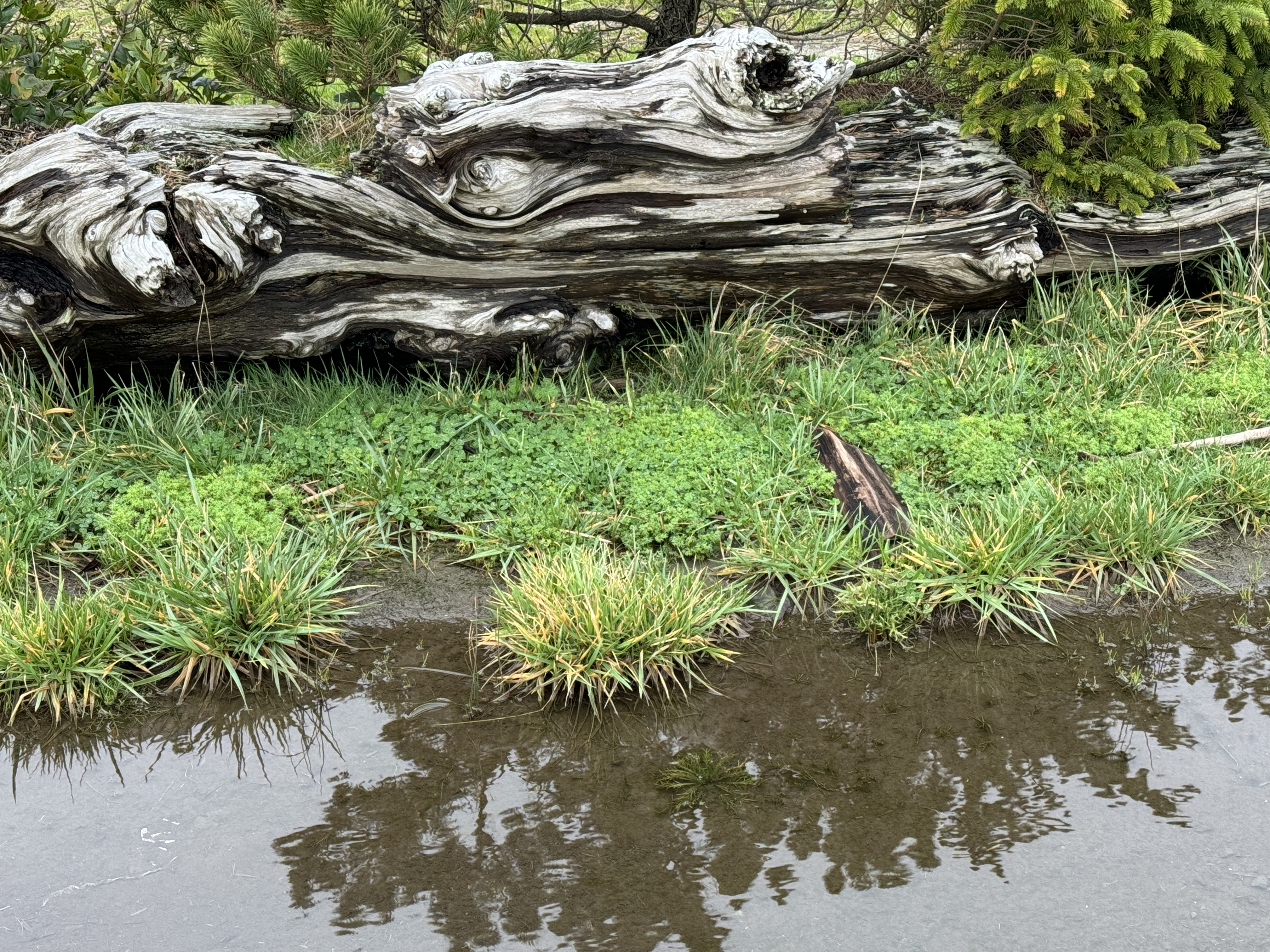
1 FebIn our Manzanita winter I’ve seen a lot of driftwood. But never one like this. This is the Rembrandt of rubbish. This should be in a gallery somewhere. The picture doesn’t do it justice, but, trust me, it’s remarkable. Those of us who feed on symbolism will spend hours deciphering the curves and edges until, finally, we see the hidden jewel. Maybe it’s a face or an animal, but somewhere in that ocean art is a feature or figure waiting to be unveiled. My suggestion this morning is that it’s better to use a telescope than a microscope when looking for meaning, symbol or metaphor. And I would further suggest that the same idea works in life generally. Better to take a step or two back to gain the full perspective, the comprehensive view, rather than viewing everything and everybody under the microscope of precision and perfection. Life tends to narrow dramatically when we live microscopically. Faith is an act of trust in the midst of unknowing. Unlike the sciences, faith doesn’t respond well to severe scrutiny. Faith, developed through rigid analysis, turns out to be rigid. Compassion suffers when the calculations of the length of Noah’s ark become more important than giving a cup of cold water in the spirit of Christ.
Most of the time life is better viewed at arm’s length rather than through the lens of a magnifying glass. And for me, the great irony is that the more I stand back from the driftwood, the closer I get to its profound beauty. The more I look at life in its fullness, not its narrowness, the more I understand myself and you as my neighbor. And, the more I look at life comprehensively the closer I come to the mind and the heart of Christ. Consider the lilies of the field, not the fourth petal of the third plant in row seventeen.


Recent Comments